220 distinct electoral races were decided for State legislative seats from New Jersey and Virginia
2 high-profile governor’s races were decided
23 distinct State legislative contests were also decided
2 special elections for the US House of Representatives were also decided
Mayoral and ballot initiative contests were also decided all across the country
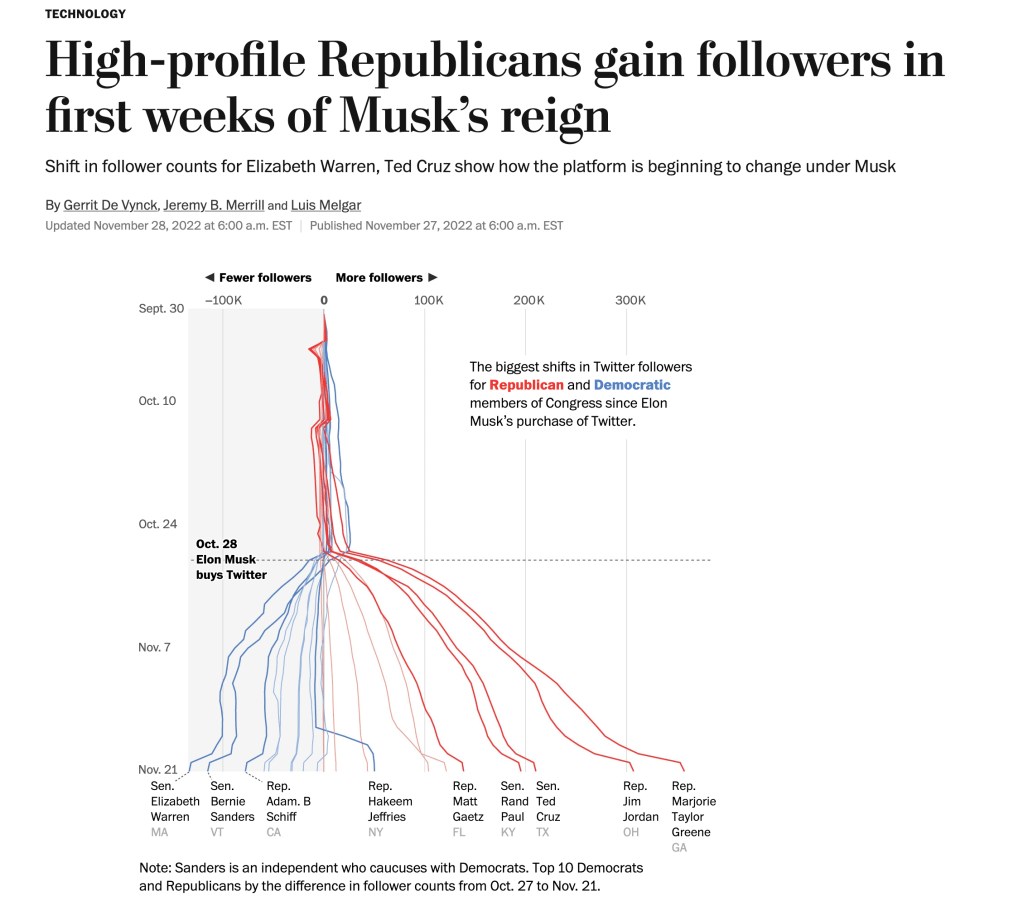
Overall, Republican party candidates fared better than Democratic party candidates and looking through multiple news outlets and aggregators, I find no mentions of ‘election fraud’ or similar ‘Big Lie’ style claims from any individuals on either side of any contest.
This, to me, is the story of today: the overwhelming majority of Republicans seemingly accept the electoral results of hundreds of elections across the countrythis time.
Four Hours at the Capitol is a new documentary on the events of January 6th this year, when thousands of Americans converged on the Capitol Building seeking to overturn electoral results they were unahppy with after being encouraged to do so by the President. For anyone with access to HBO, I would encourage taking the time to watch it.
A lot of discussion around historically abberrant civic behavior (threats made at school board meetings, armed gatherings outside election offices, violent breaches of the nation’s Capitol, etc.) focuses on Left-Right divides, but an interesting article in The American Journal of Political Science suggests that a better continuum to use may be Establishment vs Anti-establishment.
According to the researchers, it is the anti-establishment trait that “is correlated with several antisocial psychological traits, the acceptance of political violence, and time spent on extremist social media platforms. It is also related to support for populist candidates, such as Trump and Sanders, and beliefs in misinformation and conspiracy theories.” This seems to make sense . Folks aren’t joining wanna-be militias/gun clubs and decking themselves out in tactical gear because they’re just so gung-ho in support of certain types of foreign policy, limited government and balanced budgets (tenets of what used to pass for Republicanism) — they’re doing these things because they have grievance against an entity or institution, if not against the entire establishment altogether.
Further, it is possible and likely that leaders from established parties are stoking and growing this anti-establishment fervor among their constituents. And while most voters would probably tell you that politicians do not decide which way they feel about an issue, most voters are wrong.
In any event, it is worth considering how politics used to be on the Republican side of the aisle:
George W. Bush debating tax/economic policy with Ronald Reagan, 1980.
John Hallmén is a macro photographer in Stockholm who, as best as I can tell, uses an old school bellows system and modern-day frame stacking technology to combine dozens or hundreds of individual shots together to create stunning images of really small things — mostly entymology-related. Links to his work are here and here,
‘Black Ant’ by John Hallmén
AN interesting thing to consider ahead of the coming week is that four years ago, a Republican House, Senate and White House enacted their first significant legislation of the Trump Era, the Tax Cuts and Jobs Act of 2017. Through this legislation, somewhere between $1.8 and $2.2 Trillion would be added to the national debt over ten years, in order to permanently cut corporate tax rates by 18%, while temporarily reducing the tax rate for individuals and married couples by a couple of percentage points. The law did other things, like preventing estates from having to pay any taxes at all; whereas previously Estates in excess of roughly $5M were taxed, after the Act was passed, an Estate was allowed to pass the first $14M+ to its heirs, tax-free.
I think about this as the ‘Build Back Better’ (BBB) legislation is pending final drafts, and we await the final implementation on the Infrastructure Bill (BIB). Folks will complain about all the ways that either bill isn’t perfectly to their liking and folks have alredy been complaining about how ugly they find the process of legislating to be. But an experiment has been run here, and the GOP–when in power–first used its majority to run up the deficit so they could reduce taxes on corporations. Conversely, the Democratic Party has used its majority to finally deliver funding for Infrastructure Renewal and Programs to help actual people — and without running up the deficit to do it.
To me, that is the story.
Another interesting thing to think about is that there is apparently market demand for $700 wheels you can put on the bottom of your computer.
Dune was released last night. It was beautifully shot, and the soundtrack seemed interesting, but other than that, I found the movie unimpressive.
A fellow named Nick was fired this week from his job in Washington state coaching college football. State employees were mandated to be vaccinated in August, but as of late October, Nick still refused to be vaccinated. At the time of his firing, he was the highest paid state employee in the entire state of Washington.
And that, too me, is the story here.
States run all manner of organizations: Health Exchanges, Highway Patrols, Departments of Agriculture, Substance Abuse Treatment Facilities, all manner of entities that require talent, dedication and experience to operate well, but who gets the most money? The guy in charge of the sportsball team. I will think on this the next time someone mentions American values.
I wanted a Brindle. Something like a Plott hound, maybe a Staffie, even a Great Dane, but it had to be brindle. Iconic, not small, sturdy, rugged and loyal. I went to my county’s Animal Shelter, and eventually the local Humane Society and while walking the kennels there just off of Pottsburg Creek, in Jacksonville, FL, all the dogs began to go off — barking wildly at my presence, super excited and eager for something. Most kennels had a couple of dogs, and there were more than a couple of Brindle pups on site, but in one pen, was a big puppy, all black, all alone, about 5 months old with paws nearly as big as his head. Someone had scrawled a card on the kennel door with the name “ZEAK.”
He was the only dog not barking. I was intrigued. Impressed maybe. The thought of a quiet dog, one who never barked suddenly became a very interesting idea, but he didn’t look like the dog I wanted. I passed on him. Kept walking, kept checking out the other dogs looking for the proverbial one. I think I met a few dogs that day, but on a lark I asked if I could hang out with the quiet one, so a volunteer eventually brought the quiet dog out and from the moment he arrived — he ignored me, and followed her around the pen as she struggled in vain to get him to lose interest and pay attention to the prospective adopter. She kept apologizing, again and again, saying it’s because she’s the one who feeds him and that I shouldn’t take it personally. I didn’t — and in fact I thought it was the greatest mark of character that he wasn’t so fickle to just fawn over the new guy. Dance with the one who brought you, I thought.
I came back the next day after sleeping on it, and said I wanted him. But it turned out he was a flagged dog (puppy, technically), serious resource-guarding issues and minimal socialization with people. He was already 55lbs. and he was accustomed to using his teeth to get what he wanted. I had to meet with the behaviorist on site. She warned me against adopting him — probably based on my lack of experience with similar issues. She explained that the shelter was a no-kill facility (implying that he was the type that would be immediately put down as aggressive elsewhere) and that typically a dog like him would require a ton of work. She explained the work, I was stubborn, and ultimately she agreed to let me adopt him.
If the truth be told, that decision was technically a mistake. Zeke (as it is correctly spelled) eventually changed my views on the virtue and vice of ‘no-kill’ shelters but that is a whole other post. For the next few weeks he chewed through leashes while we were out walking, sometimes escaping and running wild doing zoomies and snapping at anyone who tried to catch him and hold him down. Once, he chewed through the leash at the Five Points intersection of my neighborhood during rush hour and ran out into the road going full on buck wild. Cars swerved to miss him, others swerved to block traffic, with a few drivers shifting to park and jumping out of their running cars to try and help the guy with two frayed halves of a bright red leash get this maniac big black dog back to safety. I have no memory of how I was able to actually get him the four blocks back to my place.
At other points, once I had switched to leashes that couldn’t be chewed through, he switched to using his teeth on me directly, once severely mauling my right arm (he was 65lbs at this point), mad at being restrained on a walk to Mr. Lee’s convenience store three blocks away. After bloodying up my arm, with cars flying by on Riverside Avenue, staring at the ongoing spectacle, he clamped on to my right hand to the point that I suddenly realized something I had never considered before: a dog can crush your bones. He had already punctured skin, and I was fairly certain he was about to break a few metacarpals if not all of them. I spent the next 24 hours tore up emotionally, certain that I’d failed, and certain that I’d have to give him up, that he couldn’t really be properly socialized.
Thankfully, the shelter refused to take him back.
Over the next four months or so, we got really serious. Everything became regimented. I read everything from Patricia McConnell and The Monks of New Skete and Karen Pryor to Alexandra Horowitz and Jon Katz and numerous other authors. I watched every episode of The Dog Whisper and DogTown, every documentary I could get a hold of on dog behavior and eventually purchased and read all three volumes of the Handbook of Applied Dog Behavior and Training. Within that time we were able to establish SO MANY cues (he was always great with language) but most importantly we switched from having him ask with his teeth, to asking with a sit. Once he learned that was more effective, everything became easier. But it was rough getting there.
He was not the perfect dog. As a puppy, he was great with other dogs, and kind of indifferent to people. But as he got older, that inverted. He became incredibly status oriented toward other dogs. If any dog stared at him in any way but subserviently, he would want to correct that on the spot. We often had to navigate across streets and around cars, using any obstacle available as folks walked their dogs either off leash, or on those ridiculously long retractable leashes, completely oblivious to what was heading their way. After my girlfriend at the time (wife now) and I adopted another dog, Zoe, I was scared to leave the two of them home alone for weeks, but they never got into it during those early days and eventually formed the pack that continued until about 11:30 this morning.
Zeke was not an overly-affectionate dog. But every morning he would wake up, and once on his feet, if you’d let him, he’d walk over to you and give you a lick. Just one. To let you know, you’re still cool. As he’s gotten older and as this day has slowly approached, I was more and more fond of that trait. I would always squat down and let him plant one on me and then he’d turn to go check out the water bowl or what the office was looking like, or if the dog bed in the living room might need his presence. If he heard his leash rattle, he’d amble over to the door and patiently wait to be clicked in and taken outside to handle his business. If he had to go outside, he’d come over, rest his chin on your leg and then look up at you to communicate the fact. He was a brilliant communicator. He knew nouns, he knew verbs, and he could put them together to understand the syntax. I’ve never encountered a dog better with language.
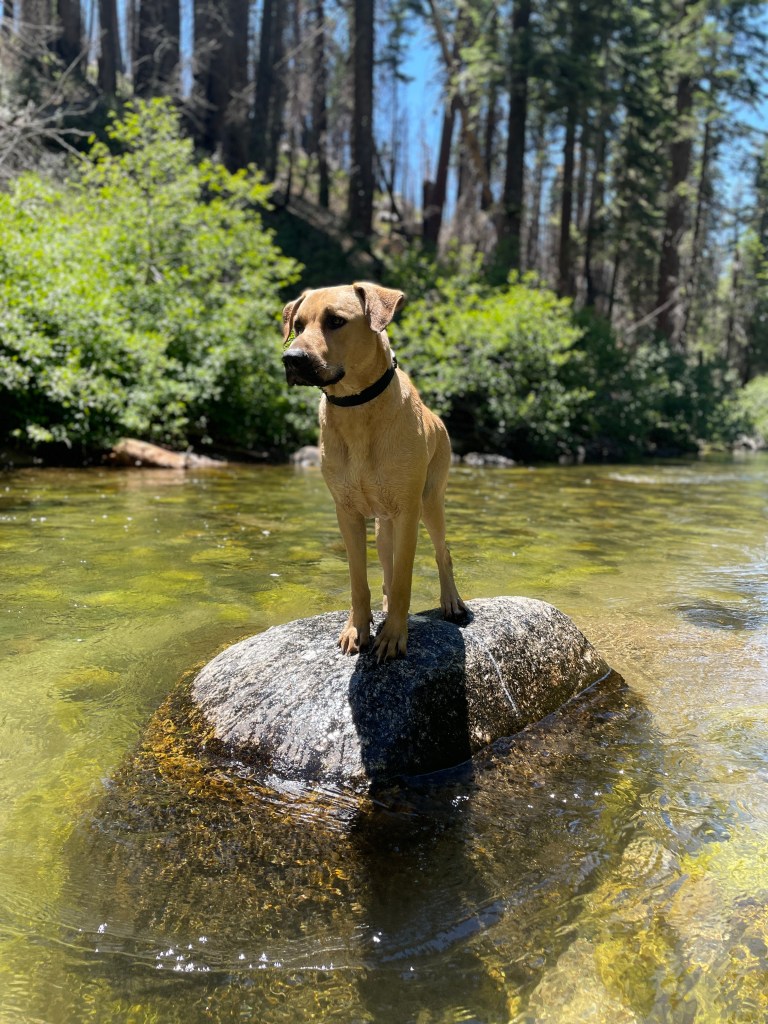
His favorite place in the world was probably our bed. As he got older and more frail, he was less able to get up there (or off there) but he would often place his chin on the top of the bed and just look at it. His favorite thing he ever ate was probably a lake-caught Trout in the Trinity Alps of Northern California. He once hiked 18 miles in a single day from Grizzly Meadows to the Hobo Gulch Trailhead in the Trinity-Shasta National Forest. He once got up on the dining room table while Sarah and I were away and then got stuck there because he felt the bench was too unstable to down-climb on. Sarah and I walked in to the apartment and there’s a 125lb dog on the dining room table whining because he doesn’t want to be there any more. At the risk of an arcane (Ghostbusters) reference, he had a face not unlike Zuul of Gozer but the weird motions of helium balloons frightened him to the point he would lock up and freeze and no force on earth could move him any closer. He loved dogs bigger than him. He loved donkeys. He was weird. He was as big as a recliner, but if there were just a few inches of space available on the couch he would insist that he could fit into it. He was a sentient, living being, but no more. He was my friend, I loved him, and I miss him.
Over 200 miliion doses of approved COVID-19 vaccines have been administered to date in the US. Many mass vaccination sites are closing and many counties are declining additional shipments of the vaccines in light of the reduced demand. Meanwhile, outbreaks are crushing India and the US is housing tens of millions of AstraZeneca vaccine, which is not approved for domestic use yet.
We should ship it. (Probably not all of it to India, but we should ship every dose, today, and keep making more)
The “it’s the right thing to do” argument is fairly self-evident, but I also wonder if political backlash from helping other (non-European) countries might animate the hesitant of the ‘merikkaFurst’ crowd to switch gears and seek vaccinations. I wonder specifically if political polarization caused increased vaccine access (under President Biden) to generate increased hesitancy from GOP aligned citizens. And I also wonder if a move by Biden to provide vaccine supply to other Out-Groups (as these vaccine hesitant folks see them) might result in increased demand, simply out of a sense of aggrievement.
Shipping vaccine to India and the rest of the world seems to me like a good move. There may be a political price to pay in the short term however the policy wins (Public and Global Health, Diplomacy) seem like they could be worth it, even in the crassest of analysis.
The meal was pre-prepared — something S. had ordered as a kit to cook on Valentine’s Day (which was a week ago) — but it was still well put together. The kale salad was complicated (I typically just go with Gomasio, Vinegar and Avocado … cherry tomatoes if I’m feeling festive) but the ingredients worked really well together. The gf, v, Alfredo was the shocker though. Always ambivalent toward parsley, the bitterness of the fresh cut sprigs cut surprisingly well against the alfredo tonight. As favorite people of mine would say at sea, “fuckin’ yumm!’
Unclear if I’ve been using sketchy parsley or just sub-par alfredo all my life but I am making a note of the combination here.
New digs!
I write this under the stars from our porch here in Oakland’s Lakeside. (Sirius, at least, is visible)
S. and I are finally moved-in to our new place. We picked up keys a week ago today, and had movers transfer numerous boxes and articles of furniture from yon to hither the following day. The three days that followed were spent cleaning up the former abode and disposing of years (a decade’s?) worth of tired accumulations. Because of this, I can report with informed sincerity that Alameda County’s waste disposal services are not wanting. (the Public Administration geek in me was highly impressed)
Since Friday we have mostly been working through unpacked boxes, finding homes for the items within, while acclimating the dogs to their new space. (We would take them with us to the old spot while cleaning) They are handling it like champs. I am having a much more difficult time with all of the plants. Finding the right spot for a new plant or two — even when the species count is triple digits — is relatively easy in a given space, but finding the right spot for all the plants, suddenly, in a different space, is proving challenging. The simple truth is that we have too many plants. Some of them will die (and I’m okay with that) as a result of the move. For the most part, they have all been in subsistence-only conditions for the last week. Interestingly, I have observed radical growth from a few, despite the decline in the conditions they are used to. Stress as a catalyst for growth — hardly a new concept in biology but I rarely get to see it in that context. And it is lovely to behold.
In any event, tonight — with the living room mostly put together and our offices largely assembled to face the coming work week — we addressed the kitchen and I was able to cook a meal, the first meal, at the new abode. I write this, a testament to the fact that I can, no longer being focussed on the packing and preparing of the move to come, or the move that is ongoing — only on the move that just was. I am looking forward to settling down for a bit, improving things, and figuring out how we can make this place uniquely appropriate to our lives and sensibilities.
-30-
currently reading: Anti-Intellectualism in American Life, Richard Hofstadter
I started Arlie Russell Hochshild’s Strangers In Their Own Land right at the start of the new year. I read the first 50 pages or so, pondering–the whole time–why I should care at all about what I was reading. (The book is about folks in rural Louisiana, and how one sociologist from UC Berkeley came to understand them by leaving her west coast bubble and truly engaging with them, in their land.) Snapshot from the cab of a pickup – stories told from a bayou living room. Oral cajun histories, mediated into a narrative of social exploration between two poles of the American political divide. I imagine the book eventually gets to some deeper points about how much we all have in common, despite our political differences, and in some undefined way, I am certain that was why I was reading it: I wanted to be reminded that we’re all in this together, we’re all good people, E pluribus unum and such.
The breaching of the US Capitol last week placed that idea in a very different space for me though. One much more distant, frankly. I find myself less empathetic, if not wholly disinterested, in GOP culture these days or in the work needed to understand “where they’re coming from” with the nonsense of the day. There seems to me to be some honest and responsible cadre of the GOP–maybe 5%–who understand the rot and the insanity and are willing to address it in good faith, and the remainder, if not fully bought in to various conspiracy theories or cult of personality are acquiescing at best, but more likely using and amplifying these trends for their own self-interested gain. My understanding is that in a sense, Strangers In Their Own Land was the first of many narratives to follow getting at ‘the trump voter we met at the diner‘ and it’s reportage ilk from the 2016 and 2020 campaigns. I wasn’t sure I needed any more word count on the subject though; after last Wednesday, I know I do not. I’ve seen enough. Hofstadter’s Anti-Intellectualism in American Life is seeming much more suitable to this moment.
Ahead of the Inauguration of Joe Biden this Wednesday, much reporting and commentary reminds us of pending protests at all 50 State capitals. For the record, I am 100% fine with protests from people distrustful of single-party rule over the next two years — or really, anything rooted in reality. I wonder though how much of the ‘Stop the Steal’ brain cancer is fueling this though and how much of it will be on display. I also wonder how much violence will be able to be done by folks using the protests for their own ends.
I also do not think the President is done trying to thwart the legitimate transfer of power. Even at this late hour.
currently reading: Anti-Intellectualism in American Life, Richard Hofstadter currently listening: Evermore by Taylor Swift
The polls closed tonight on the US Senate run-off elections in Georgia and I am fascinated by the distance I have maintained from the contest. The outcome will undoubtedly have consequences legislatively and beyond, however I am completely at peace at this moment.
There is a California Buckeye Tree that grows in Strawberry Canyon (Berkeley, CA) that is quite singular – even if my hunch that it formed from two saplings is correct.
Aesculus californica, the California Buckeye
I have spent the last week away from work and began 2021 with a focus on the house and back yard, working to improve and simplify things in form and function. It has been productive. Things feel quiet. Enough small details have been remedied that it feels like there has been a noticeable change. I am looking forward to occupying this stillness as much as possible and to keep slowly improving each room, and each thing.
-30-
currently reading: The Beauty of Everyday Things, Soetsu Yanagi last full listen: High in the Sky by the Hampton Hawes Trio