Lessons learned, Year 1: unless operating at a significantly larger scale than we currently are, and with no single, dedicated space to incubate and raise vegetable starts from seed (and especially without a *nearby* spot to harden-off the plants for their final two weeks) it generally is a losing proposition in terms of time and effort.
At $4 per vegetable ‘start’ sold at a retail nursery, a $200 outlay in late-April would save the expense and effort of buying and tending to seeds, soil, trays, etc., (approx $35) throughout the preceding 8-10 weeks,. Given that perhaps half of a 375-square ft garden area will be occupied by vegetables that do best being direct-sown, when averaging 24″ between plants, the total count of plants from each approach end up being about equal. The additional cost in dollars is $170; the savings are 10-12 hours of work as well as the space and cognitive overhead involved throughout Feb, Mar, and Apr.
Another significant benefit is that ‘starts’ are generally significantly stronger and closer to maturity. The only drawback I immediately recognize is the smaller selection of cultivars available as starts.
currently reading: The Common Uncommon by Berndt Heinrich (2026)
last full listens: I’m only F**cking Myself by Lola Young and Concierto (CTI Records 40th Anniversary Edition) byJim Hall (1975).
“…grow the right plants for cutting: annuals and biennials, for example. Start them off from seed, then pinch out the seedlings when three sets of true leaves have formed: just squeeze off the growing tip between your finger and thumb. This gives a much bushier and more productive plant… stocky not whippy…”
“Picking above a pair of leaves promotes axillary bud formation. By picking one flower, you create the potential for at least two more in a week or ten days.”
“Sear to stop flopping… plunging stem ends into boiling water to maximize a flower’s longevity… the time in the boiling water is proportional to the texture of the stem. Soft stems…few seconds…. woody stems more like 30 seconds… The length of the stem you sear is proportional… about ten percent of overall [stem] length…. keep flower heads away from the steam. Enclose them in a sheet of newspaper if you need to.”
Rest the flowers overnight…”somewhere cool… cold but not freezing, makes a huge difference to the vase life of any flower.”
“Some flowers, such as hellebores, hostas, hydrangeas and peonies, benefit from submerssion. Float them in a large bowl, sink or bath of tepid water, pushing them below water level, the whole flower head as well as the stem. A few hours will do, but if you can, leave them overnight.”
-Sarah Raven, teacher, broadcaster, author. [Podcaster of ‘Grow, Cook, Eat, Arrange’; owner of sarahraven.com]
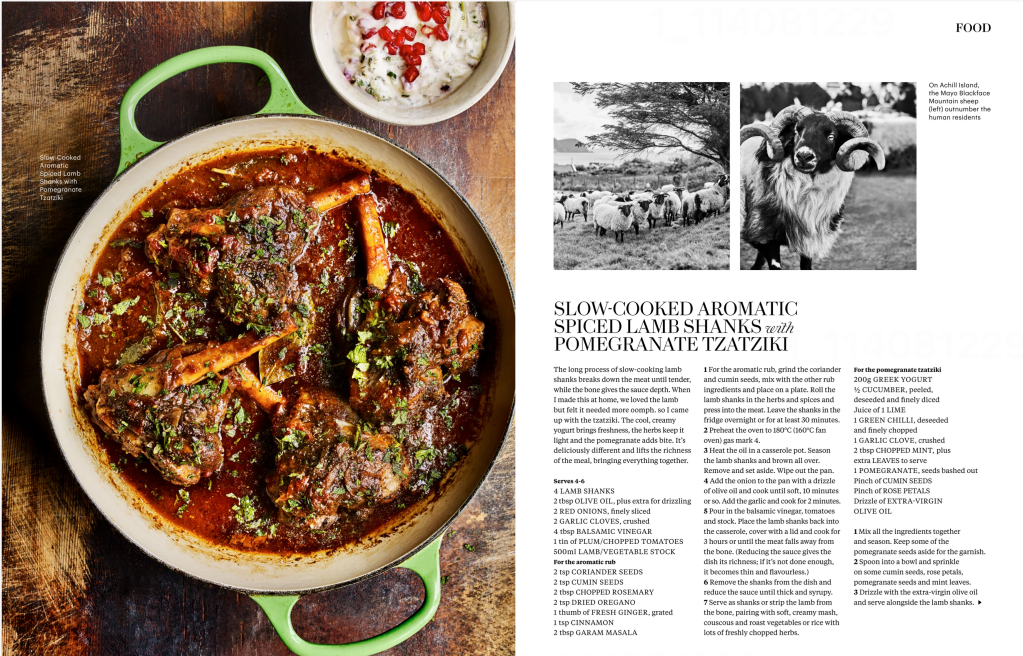
Ideas for leftover mashed potatoes and lamb shanks:
In 1966, George Hoffnagel and Chet Poetsch worked at Richardson-Vicks, Inc. and came up with a “liquid, multi-symptom relief formula” to promote Nighttime Tranquility for those batting the common cold. This was the first of its kind. We know it by the name NyQuil.
After dealing w a cold the last three days, I feel that Hoffnagel and Poetsch deserve far more credit for their contributions to society. (They should be household names.)
Made the Green curry from The Hog Island Book of Fish & Seafood.(p. 196) last night, substituting the Black Cod w/ wild-caught (Chesapeake-invasive) Blue Catfish. Cod is an odd choice for such a ‘Thai’ recipe. Occurred to me while cooking that catfish are far more emblematic of Southeast Asia.
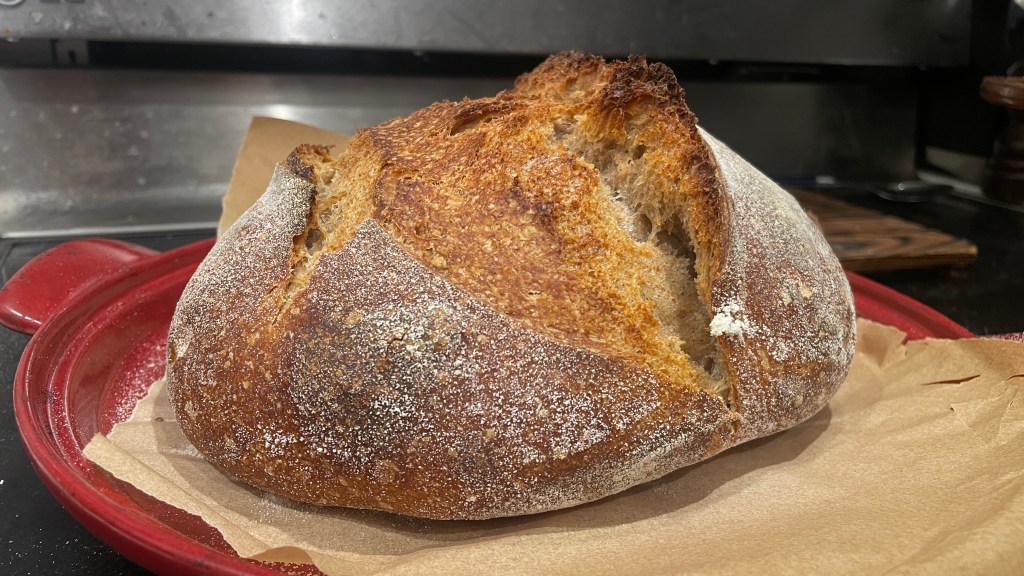
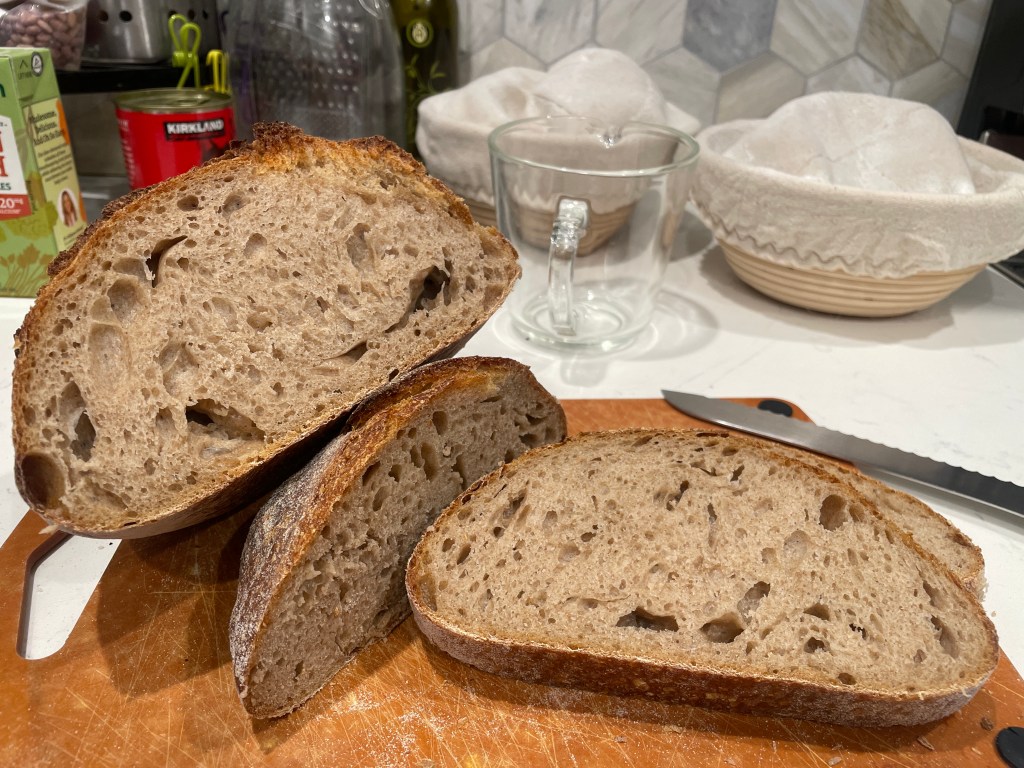
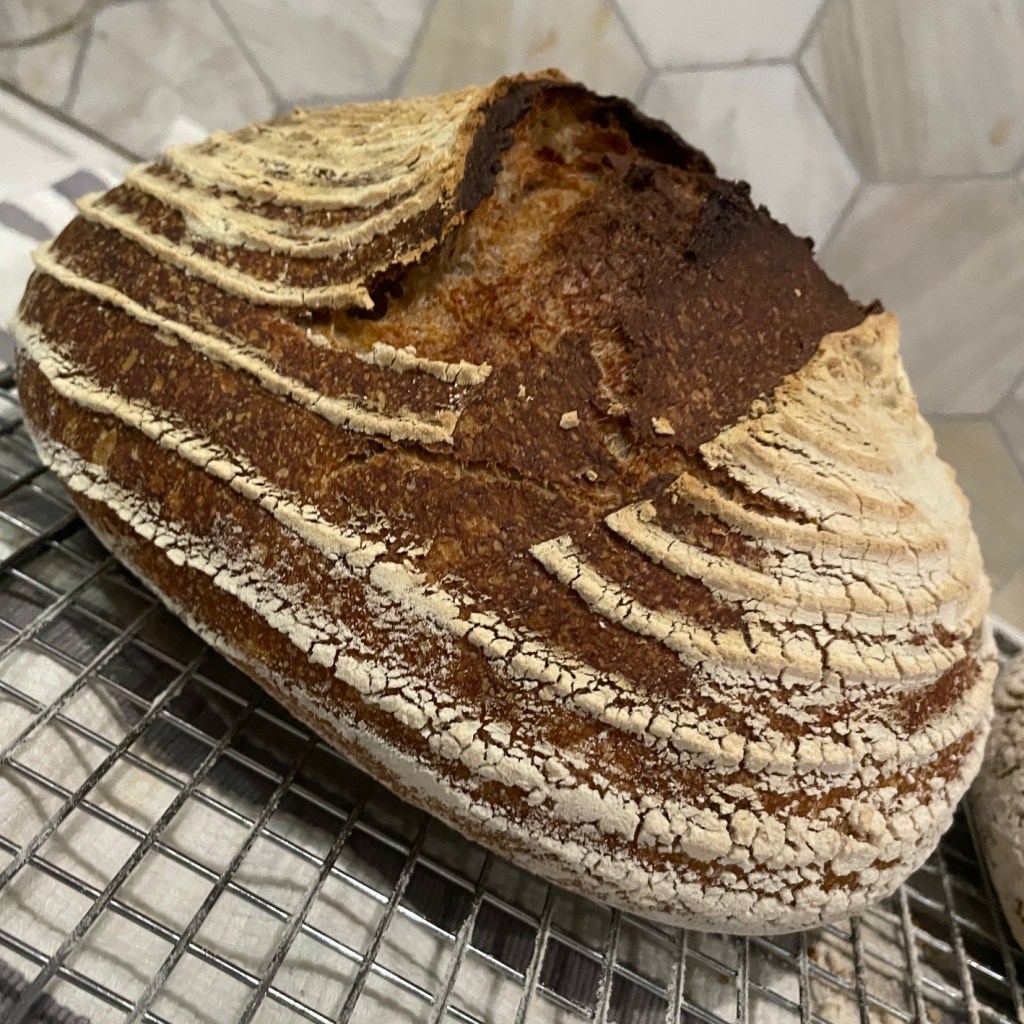
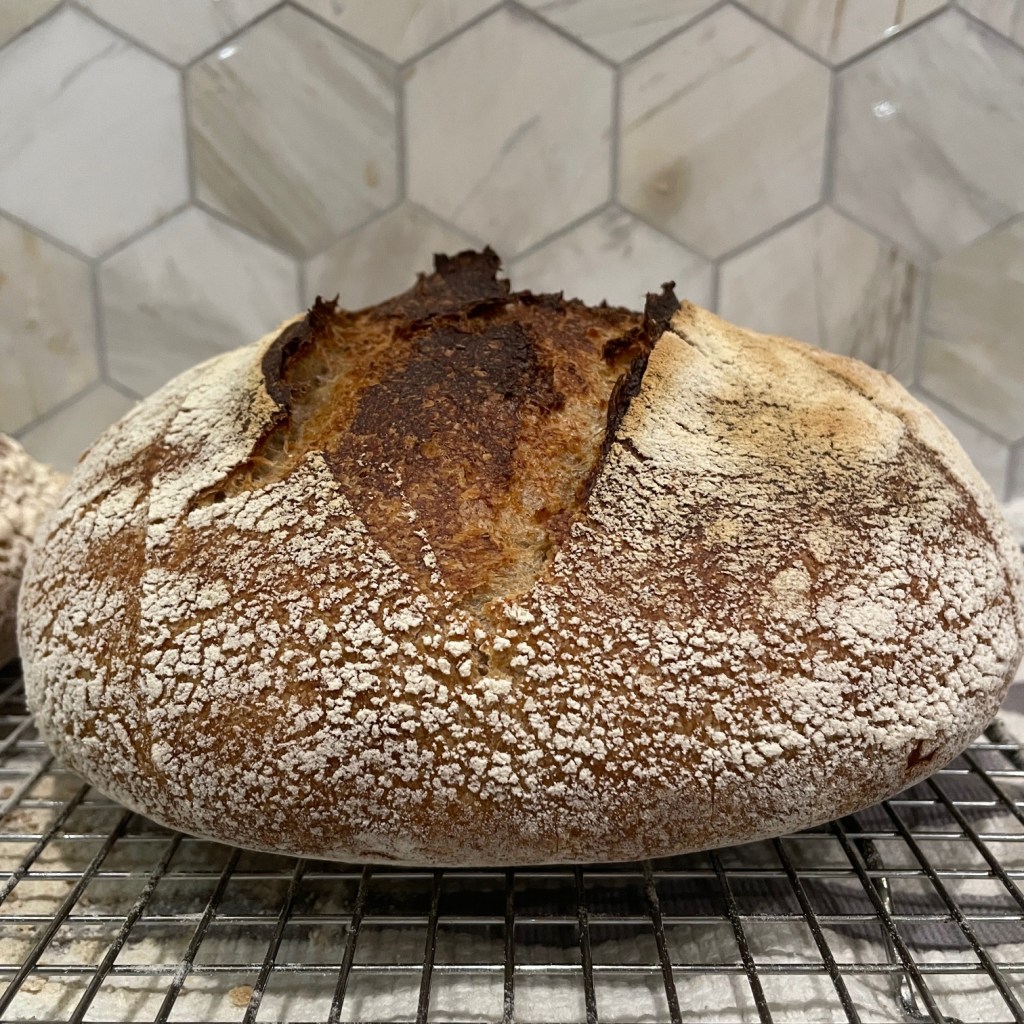
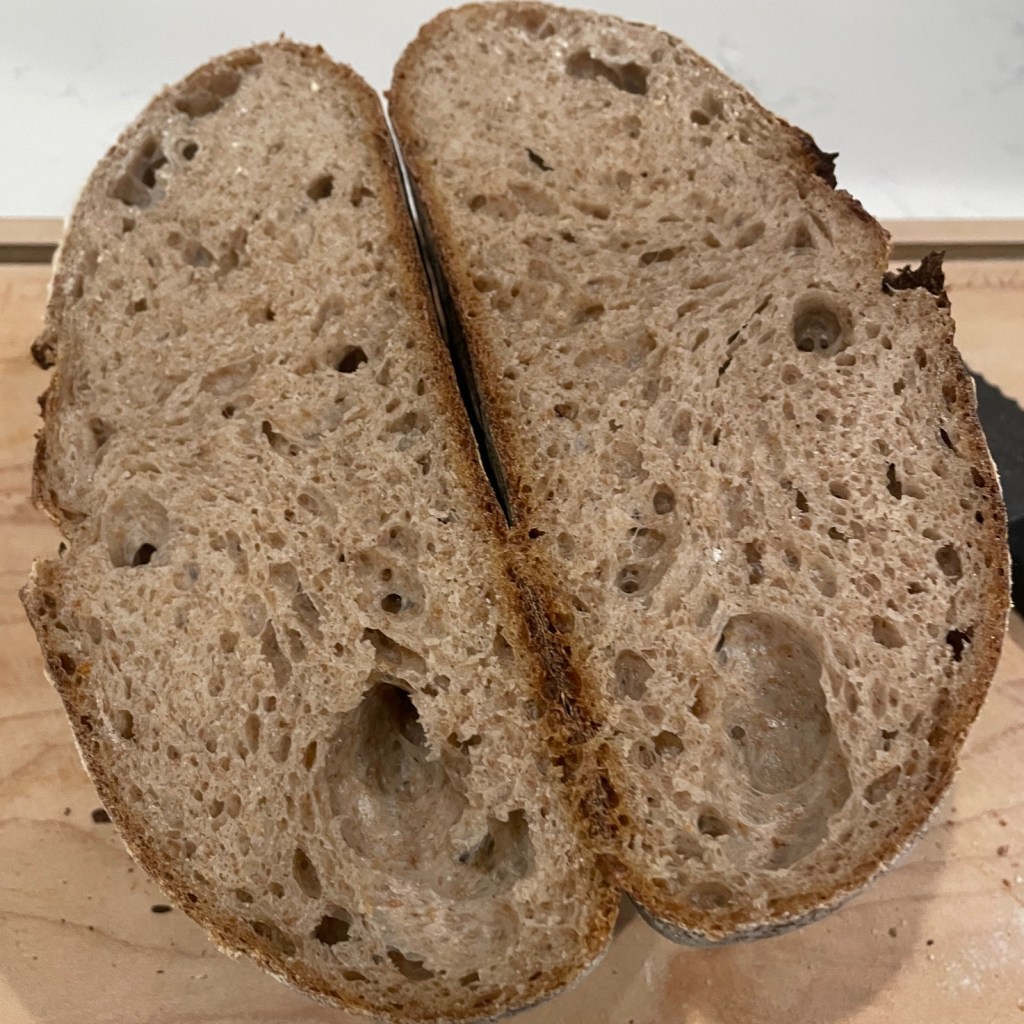
Woke up this morning and continued working on a pair of Bread Bible-inspired and over-hydrated sourdough loaves. Two new variables this week: The starter had been going cold and slow (between 48 and 54’F) since mid-week to develop more lactic acid; also, tried to experiment w/ a ‘sponge’ preferment, but the dough ended up a fair bit slacker that I’d have liked. Decent oven spring gave the bread a fair shape, but we will see how sour it tastes tomorrow morning after the bread has cured overnight.
[Bread was fine. more sour notes; – on the right track. Main area for improvement: consider adding flour near end of bulk fermentation if dough remains slack.]
(memorializing: 40% of the flour and starter to 100% of the water was combined Saturday @~noon -ish followed by 90 miinutes at room temp, and then into the fridge. Sunday morning (18-ish hours later) mixed in the remaining flour and sourdough starter, then the salt and then begin bulk-fermentation @ room temp. A lower hydration or different flour is needed in the future, and I suspect that 100% of the flour into 40% of the water would work far better as a pre-ferment).
Also made these Apple Cider Doughnutsfor the first time this morning. Eating them while warm is a wasted move; once they fully cure though they’re quite amazing.
“Les beignets au cidre est un plat qui se mange froid”
50 tomato plants were started this week: Aunt Lou’s Underground Railroad, Mountaineer Delight, and a cherry tomato named ‘Everglades.’ SEEB started a 50-plant flat this week but not sure what’s in it. We should have enough seedlings to put in the ground by the time last-frost arrives (or doesn’t). Still have more seedling trays that can be filled. Still need to pull up more sod. We expanded about 40ft2 of vegetable garden plot this week (on Monday). Rain gardens are topic of discussion – probably two in the back yard are in store,. Need to look at sheds still. Need to make a level platform for the recycling/garbage cans still.
Daffodils are blooming. There are buds forming on many of our trees and shrubs Rain is in store next couple of days and a few sub freezing nights are forecasted as well.
currently reading: The Food Lab : Better Home Cooking Through Science, J Kenji Lopez-Alt
last listen: Mer de Revs by How to Disappear Completely (2018) and Fables of the Reconstruction by R.E.M.(1985)
Made two boules today. 13 hours, start to finish. I’ve been under-proofing sourdoughs consistently of late and judged the bulk-fermentation solely on rise today– probably for the first time. It took 7 hours to get to a solid 50+% rise in the bulk stage despite the house being ~70’F. No over-proofing took place though and they had great structure, and solid spring. Best ears I’ve seen on a loaf of mine since California and the dough had all the integrity you want as it was moved from basket to oven.
Watch the rise; not the clock. (the morning after)
Started 40 Broccoli plants today (Nutri-bud, & Waltham 29s) and 20 Morden Miniature Eggplants. One day there will be jars of makdous that all started as seeds on February 22nd. Set up 2 window sill seed trays with 40 more cells for next steps.. .
last listens: Rant and Rave with the Stray Cats by The Stray Cats (1983), Abattoir Blues/The Lyre of Orpheus by Nick Cave and the Bad Seeds (2004), No More Shall We Part by Nick Cave and the Bad Seeds (2001), Abbey Road bythe Beatles (1969), Break Stuffby the Vijay Iyer Trio (2015)
Last Watched: The Bear, Season 1 (FX)
Currently reading: books on garden design, books on cooking.
simply noting: I am at the point where I have to check the authenticity of videos as milquetoast as this (when they show up in my Instagram feed as this one did for example) to trust that they are not DeepFakes/AI disinformation thrown into the digital ecosystem.
I began a sourdough starter last weekend and ended up makiing a pair of sourdough loaves this weekend – the first ones I believe I’ve made since leaving California. They came out better than I expected for having such young starter and having been out of the game so long. Breakfast this morning was smashed avocados on toasted sourdough, and it was on point.
Meta only shows its users' online friends 17% of the time on Facebook -- and only 7% of the time for Instagram. The majority of time is spent serving viewers "unconnected" short-form videos "recommended by AI-powered algorithms Meta developed as a direct competitive response to TikTok's rise, which stalled Meta's growth."
A pair of Eastern bluebirds were spotted along the C&O Canal three days ago. I didn’t expect to see those this far into winter but I have since read that the population is not entirely migratory; many individuals stay in their breeding territory year round. This morning, when I opened the living room curtains, there were four bluebirds at and under the bird-feeders at the front porch. Another pair — seemingly larger than the original four — arrived at the suet feeder about two cups of coffee later.
I stumbled on to Pieter Bruegel the Elder a week or two ago, a European artist living in the time just after Martin Luther published his Ninety-five Theses. The scenes in his work are very often the people and the landscapes around him — not the wealthy and powerful. Although he engaged in commissioned and religious work, his overall body of work seems to represent a democratic shift in who was allowed to be the subject of artistic works. As far as I can tell,his winter scenes seem to be the ones that resonate with the largest audiences, although I prefer scenes like The Fall of the Rebel Angels:
Pieter Bruegel the Elder, 1562. Oil on Oak.
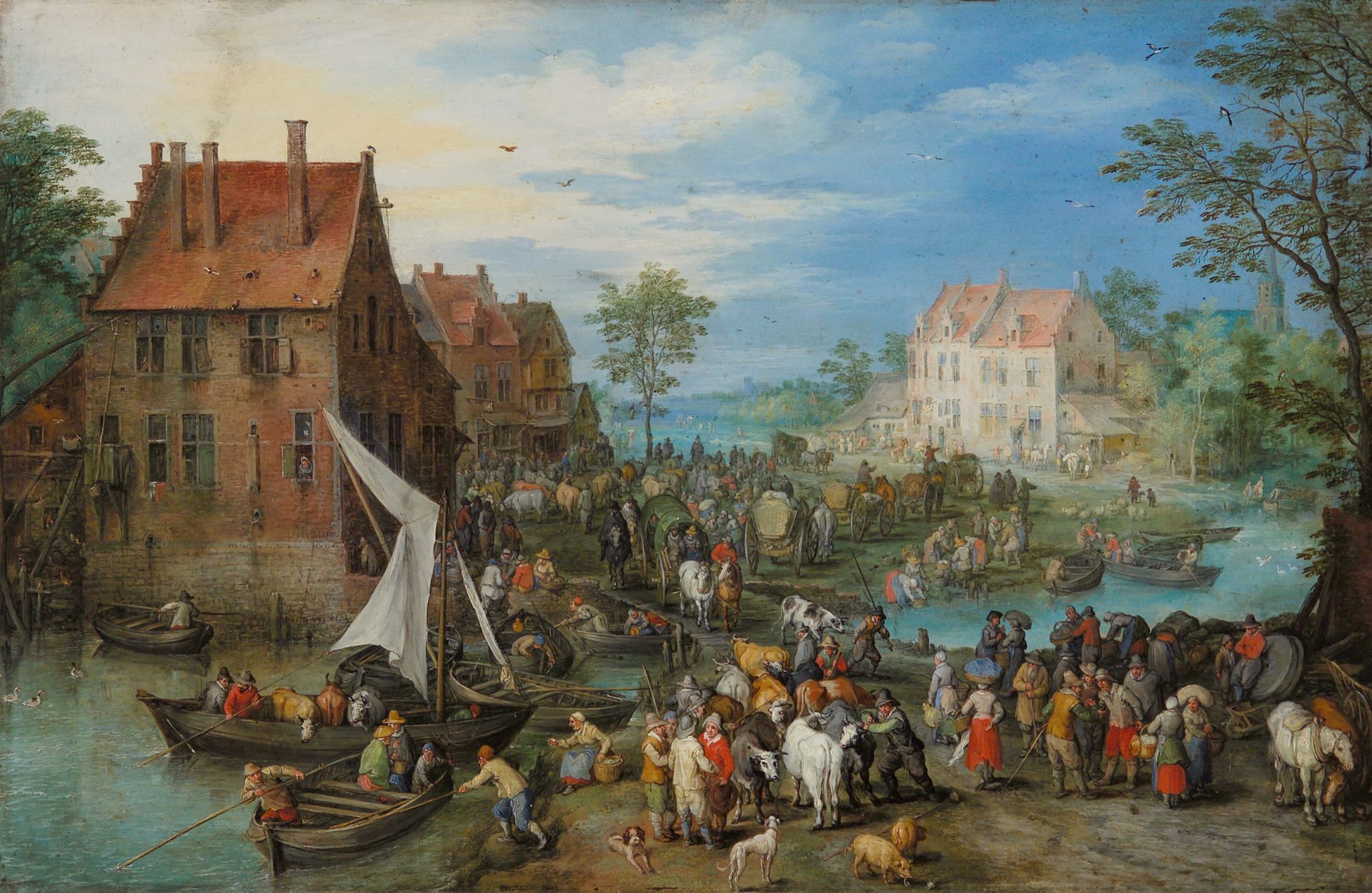
Coincidentally, his son, Jan BruegeI created a painting titled The Flemish Fair, which was made into a ‘Fine Art Jigsaw Puzzle’ that currently sits on one of our bookshelves. SEEB has had this puzzle since before we met 13+ years ago. The Bruegels have been with us this whole time.
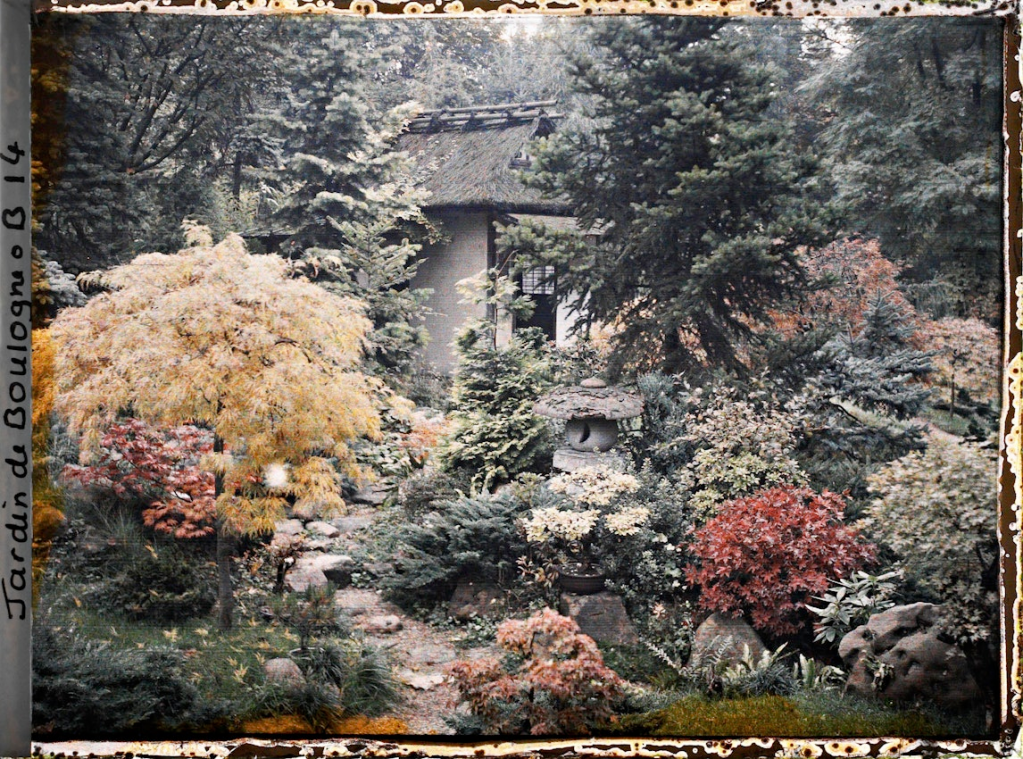
a ‘Japanese Tea Garden’ in Boulogne-Billancourt, France. 1910.
Unrelated, the photograph above is an early color photograph (an autochrome, specifically) from the collection of Albert Kahn. I post it as an example of both garden design I like and a photographic aesthetic I would like to pursue with the Polaroid received for Christmas this year.
Spent some time on a relatively untraveled stretch of Maryland’s Gunpowder river; my first time there and covering 2 miles of water (6-7 hours) I only saw one other angler. He had come in from a different point, aiming to cover some of the same water — just from the opposite bank and he started a little later in the day. Most of the banks on this stretch were about 6 feet above the water line but there were periodic egress points through the vegetation to begin reasonable approaches to the water. Most of these, however, resulted in slipping on the slick mud and unintentionally sliding down the bank into the water. Success quickly became doing so without making noise on the water or making much of a wake. I did okay after that first one.
I was looking for Brown Trout. Mostly, I caught Fall fish on the day. I had never seen Fall fish before; they are a new species for me. They ranged from 8 -12 inches and seemed to really stack up in places. In one run, I pulled at least four from the same 20 foot stretch despite the commotion and splashing made by the previous fish. I imagine there were quite a good number more in there, but eventually the spot turned off and I moved on. They (rightfully) fight hard enough, but 6x fluorocarbon is too much for them and they’re quickly to net. They seem to jump more than brown trout, not nearly as much as the wild rainbows back west — even in the net however, it takes a while for the Fall fish to settle down it seems.
These fish can sometimes reach lengths of 20″, but typically are much smaller. Larger fish of the species are called ‘Shenandoah Tarpon’ – but mainly, folks dismissively call them ‘chubs’ (a moniker they share with the similar-looking Dace of the area). Fall fish happen to be the largest native minnows found on the East Coast of the United States, for what that is worth.. [… and having gone down that rabbit-hole, I will also volunteer that the Colorado Pikeminnow is the largest native minnow in the US (up to 6 feet long and 40 lbs) adding further, that the Siamese Giant Carp of Indochina is the largest minnow, period — one being recorded in 1994 at 6ft and 330 lbs.]
The Fall fish in the picture above was simply notable for its winning personality. They photograph well — silvery bodies with darker tops to blend in with the river bottom — and those beautifully large and pronounced scales, of course. The tarpon reference is well-informed, if only for aesthetic qualities and not size or the ability to mangle and ultimately break a young man’s 3|0 hook or spool you while you’re running down the beach on the wrong side of the surf. It is a good looking fish to my eye. The fish in this photo went for an olive quill-body perdigon, tight-line drifted across the bottom of the river (just before the swing started as I recall) and after calming down, was sent back on his way, perhaps a little-bit wiser.
Earlier in the day, the high point of the day occurred while standing on the river bank peeking out through a double-door size opening in the vegetation and trees, staring at the water — trying to read what was happening in the river. A bald eagle flew from upstream, seemingly oblivious to me until it was about 6 feet from me, maybe a foot higher than eye-level. He swung his head right, noticing me right as he passed, and then did a solid bank to his left to get some distance, turning back upstream, looking at me again, and then started climbing back up (to safety?) reaching what I imagine is one of his usual perches in the largest bare White Oak that lords over the entire area. No nest observed, but he stayed there for the next twenty or thirty minutes while I worked through a nice little run from the other side of the river — until I looked up at some point and noticed him gone. I have never been so close to an Eagle as that moment, and I like the idea that we were sharing that stretch of river, each of us looking for fish in our own ways for a nice little stretch of time.
I will also note that when I arrived (still well ahead of sunrise) the first spot I entered on the river brought out a grumpy beaver who swam out, not quite half-way across the river, and started in on the tail slapping threat-displays. I am increasingly annoyed by those guys, but respect that they belong in the ecosystem. The thought of getting into it with a beaver is kind of ridiculous though — if you lose that, then you have to explain that your injuries are from a beaver — and it you win that fight, congratulations you beat up a beaver, a fact that will literally impress no one. To boot, I have to imagine that tail-thumping warns the fish that predators are about.
Best to just move on.
Finally, summer is officially over. The days are colder and the nights start sooner. Leaves are on and in the water. There is not enough light after work to make it worth driving out to the Potomac (which has been high and brown over the last couple of weeks), and unless I decide to start mousing or night-fishing, consider the Potomac back in the category of being accessible only on weekends. I feel good about my connection to the Potomac though — that I’ve learned at least a solid few miles of it really well this year– and that I know more about its changing character through the seasons, an aim I’ve been working on this year. It is a good river, and I never cease to be amazed at how completely alone you can be when you’re in it, smack dab in this middle of a metro area of millions.
currently reading: Playground, Richard Powers
Last full listen: Trail of Flowers by Sierra Ferrell