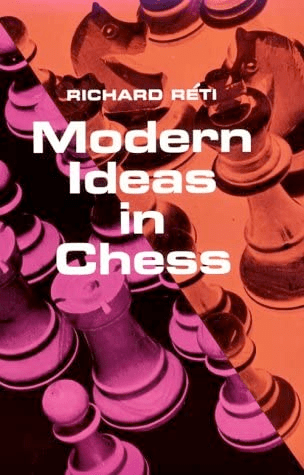
Most chess enthusiasts at least know the name, Réti, but until about a month ago, I had no idea this book even existed. As part of a training regimen I was recently given a choice for required reading between two titles, this being one of them. I could not find any used copies of the out of print book online and thus resigned myself to studying the other title. Then last week, on a shelf at Second Story Books in Rockville, Maryland, sat a perfect, unread copy of a 1960 printing from Dover Publications. The first I’d ever seen.
The listed price was $6, and all books there are 50% off the listed price. I have been reading this at the dog park over the last week, with some stints here at the house. It is a quick read, but one whose benefits, I believe, will linger.
In this book, Reti sets forth on the task of concisely illustrating the preceding hundred years of chess. He begins with Adolph Anderssen (b.1818) who leads into Morphy (b. 1837) and illustrates the ideas and developments of each successive era. That the book itself is written from a vantage already almost a century in the past, reading it was exceptionally insightful and made me–makes me–wonder: What have we forgotten?
I was born in 1974. I grew up post-Bobby Fischer, but in terms of chess culture, the world I knew growing up was one in which the Russians still dominated the game. As far as I knew, it had always been thus. Yet here in 1923, this Austro-Hungarian (later Czech) Master published an entire chapter titled AMERICANISM IN CHESS where he extolled the virtue of American Chess, deeming it superior to that of his native Europe and predicting that the future of chess (and more) belonged to the Americans.
For such is the strength and weakness of the European thinker and plodder, that he always strives after the impossible. The American is steady and turns what is possible to account…
To the European mind has undoubtedly belonged the past; possibly to Americans belong the present and the future.
-Richard Reti, Modern Ideas in Chess
About twenty years ago Garry Kasparov, arguably the strongest player the game of chess had ever seen, was releasing his series of books: My Great Predecessors. In these volumes, he systemically covered chess history in the modern era through the games and lives of past World Champions. The knock on that series–and one that I tend to agree with–is that the content is too intense. Countless side lines and variations and histories of which moves had been played from exact positions all added up to muddled and confusing incomprehensibility that few can cut through. Réti avoids all of that with simplicity and brevity. He provides no more than a single game per each Master mentioned, and the games themselves are only analyzed to the point of illustrating what each successive master brought to the game. He sets out to explain in prose and then support through concise presentation.
Anderssen – and his brilliance in calculating sacrifices and combinations. Morphy–playing the exact same position faced by Anderssen–and declining the immediate combination or attack and opting instead to develop his pieces to positions less favorable in the moment, but exceedingly advantageous within a short series of moves. Steinitz, later facing similar positions to Morphy, but having an approach to placing his pieces in accordance with more static and permanent features of the developing position. On and on for another 160 pages! Tarrasch. Lasker. Pillsbury. Akiba Rubenstein. Capablanca. Alekhine. With mentions and commentary on other notable figures throughout the years: Maroczy, Jaenish, Chigorin, Breyer, Schlechter, and more – namesake discovers of opening variations and positions students of the game study to present day. Réti provides an easily comprehensible context and chronology of them all in this short 180 page work. It is a beautiful thing.
For anyone who is interested in the history of chess or maybe even the history of ideas, this book is a must read. If one considers themselves a student of the game, and particularly if they utilize the study of so-called “Master Games” to improve their play, then this book becomes almost a Rosetta Stone. I have recently been studying Alekhine for example, and had a hard time understanding all but his tactics and endgames; the context Richard Réti provides on the ‘hyper-moderns’ illuminated much for me, by way of example. The book is not for understanding why Akiba Rubenstein –or any other Master — was brilliant in all the ways he was brilliant, but rather to show how each of them fit in the legacy that is the birthright of most anyone alive today.
In short, the book is amazing, and I would argue even more relevant today than when it was published a hundred years ago. If you are remotely interested in the book, obtain a copy and give it a shot. You will be glad you did.
 griff.works
Leave a comment