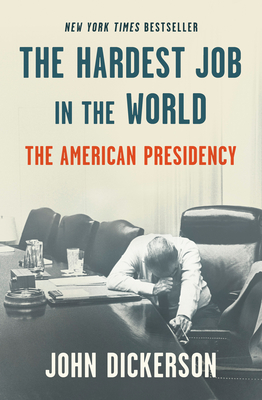
As advertised, only more so is how I would describe John Dickerson’s latest, The Hardest Job in the World: The American Presidency. For anyone who happens to be unfamiliar with the former Face the Nation host, Dickerson is a journalist and commentator, currently assigned as a 60 Minutes correspondent and a political analyst for CBS News. He is also a presence in the podcasting world as a frequent guest on many shows, one of three co-hosts of Slate’s (weekly) Political Gabfest, and the host of his own podcast, Whistlestop (which is also the title of a previous book on the history of presidential campaigns).
Dickerson has been looking at the Presidency for a while; what he delivers in this book is a phenomenal survey of the office. If one wanted to understand the history and evolution of the American Presidency and gain insight into how the duties and challenges of the Presidency have been met since the founding, this book is a great place to start.
Dickerson seems to do his level best to keep opinion out of the text, which I imagine is no small feat. This is not a book of Good Presidents and Bad Presidents; this is a book about the Executive. He writes a book about characters that have such wild differences in character that even the juxtaposition of two individuals can come across as a swipe at the one who may be viewed less favorably by one reader or another. Could you contrast someone like Eisenhower or George Washington to Lyndon Johnson for example, and not make Johnson appear like the surly, self-interested, S.O.B. he surely was in many respects? Dickerson can–and does. (LBJ is on the cover as it happens) Chapter 29 may be the most gracious and well-articulated Case for Trump {from the view of his supporters} that I have ever read. But many reader reviews seem to reflect a reflexive disdain for any presentation of facts unfavorable to ‘their guy’ and claim the author is clearly biased – an inaccurate charge in my estimation. The book is focused on the roles and powers of the office – how those have changed relative to Congress and the Courts – and the approaches and decisions Presidents have taken – how they have worked politically or practically for a given President and how all of this has served to shape the office over time. Dickerson does this fairly and with great insight, but if a bad word or two about any President will cause offense, then this is ceratinly not the book for you.
There are a great many anecdotes and narrative threads in the book (although not 45 – this survey is not complete or chronological) and the writing is superb. Dickerson does not sacrifice the narrative to make a point or make any sharp pivots to force peculiar insights into the text. Instead, he has simply written a page-turner. He has told a great story. One that happens to be true, and is about the American Presidency.
-30-
 griff.works

Leave a comment