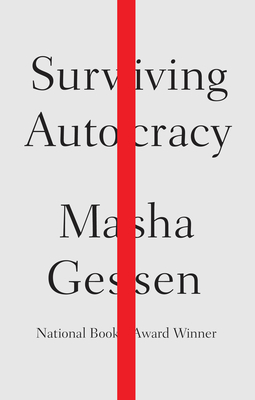
The latest title from Masha Gessen might reasonably be found in any stack of recent books speaking to the deficiencies of the current administration. There is no shortage of titles on that topic, but Surviving Autocracy stands apart with distinction due to both the depth and the precision of its analysis of American politics, processes and institutions during this moment. While many recent books provide details of previously unreported events, Ms. Gessen speaks primarily to what has always been in plain view since the beginning of Trump’s foray into civic life, and does so in a way that provides both insight and tools to more effectively understand, and thus evaluate, the changes occuring in the political culture of the United States.
She draws on the scholarship of many countries in the former Soviet-bloc which saw instances of political realignment towards autocracy during/after the decline/collapse of the Soviet Union. She also clearly draws on her close observations of her native Russia. Most notably though, she draws on an incredibly keen analytical skillset to evaluate and explain events, stripping away what might generously be understood as lazy language or indequate terms and metaphors which are generally (or have been generally) used to describe various circumstances or events. On this latter point alone, I would recommend the book; the rigor of rational analysis contained is a fine example to behold and in my estimation would be a useful touchstone to have for almost anyone’s analysis of topics they find meaningful.
The claim is not made that the United States is an Autocracy, only that what has been happening in front of us over these last three years should be understood as an ‘autocratic attempt‘ — an attempt to consolidate political power with a single individual. Even if one assumes that this attempt will fail, her argument proceeds, if there is a belief that Democracy winning the day is inevitable, the extents to which the autocratic attempt has been successful to date should serve as a dire warning, demanding re-evaluation of the assumed resilience of our institutions and political culture to sustain a Democracy.
-
a system of government by the whole population or all the eligible members of a state, typically through elected representatives.
Many reader-reviews of this book seemed to focus on a lack of steps or actions provided by Masha Gessen to “survive autocracy.” The frequency of this notion did make me skeptical of the fidelity to the topic implied by the book’s title (the bait and switch from title to text is an ongoing annoyance of mine) however, the criticism (such as it is) seems absolutely unwarranted. A fair amount of insight and utility is there for any individual who is less interested in what to think and more in terms of how one might think more critically. But beyond that, the book as a whole seems more properly understood–in terms of its title at least–as applying to the project of Democracy itself… how it, through us, resists the forces currently pulling the nation toward an Autocratic government. This resistance requires clearness of thought, precision of expression, resistance to the politics of humiliation, an adherence to the importance of moral leadership and ethical conduct in civic life, and a refusal to allow xenophobic impulses to diminish the scope of who is “we” and who ‘us’ defines in this common project.
I recommend this book.
-30-
 griff.works
Leave a comment